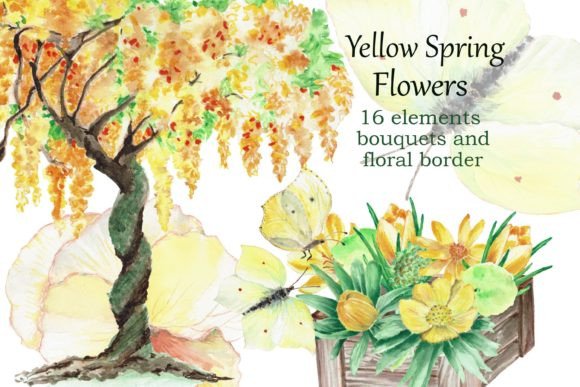
Evaluating Spring Yellow Flowers Watercolor PNG for Professional Design Projects
Integrating organic, hand-painted elements into digital design requires a careful balance between aesthetic warmth and technical precision. For designers, event planners, and brand strategists working on projects centered around renewal, celebration, or natural beauty, Spring Yellow Flowers Watercolor PNG assets offer a distinct advantage over generic vector illustrations or stock photography. This specific category of digital resources—characterized by high-resolution, transparent backgrounds and a hand-painted texture—serves as a versatile foundation for everything from wedding invitations to complex branding packages. Understanding the nuances of these files, particularly a curated set featuring garden flowers like Anemones, Crocuses, and Pansies, is essential for making an informed decision about your creative toolkit.
Defining the Aesthetic and Technical Value
At its core, a collection of Spring Yellow Flowers Watercolor PNG images represents a bridge between traditional artistry and modern digital utility. Unlike flat vector graphics, which can sometimes appear sterile or overly uniform, watercolor clipart retains the irregularities of human touch. The pigment variation, the soft bleeding of colors at the edges, and the subtle texture of the "paper" grain provide a depth that resonates with audiences seeking authenticity. When these elements are rendered in vibrant spring yellows, they evoke specific psychological responses associated with optimism, energy, and the arrival of warmer seasons.
From a technical standpoint, the quality of the source file dictates its usability. High-quality sets, such as those offering 19 unique elements at 300 DPI with dimensions around 3000 x 3000 pixels, provide the necessary resolution for both screen and print media. The PNG format with a transparent background is critical here; it allows the designer to layer these floral elements over various textures, colored papers, or photographic backgrounds without the unsightly white boxes that often plague lower-quality JPEGs. This transparency is what makes them suitable for delicate applications like diary borders or intricate wedding invitation layouts where the flower must interact seamlessly with typography and other design components.
Comparative Analysis: Watercolor PNGs vs. Vectors and Photography
When evaluating resources for a project involving Bohemian Boho themes or elegant floral borders, designers typically weigh three main options: stock photography, vector illustrations, and hand-painted watercolor PNGs. Each has its place, but the watercolor PNG offers a unique middle ground.
Stock Photography provides ultimate realism but lacks flexibility. A photo of a crocus or pansy is fixed in lighting and angle. Integrating it into a graphic design often requires complex masking and color grading to match the rest of the composition. Furthermore, photos can clash with stylized typography. In contrast, Spring Yellow Flowers Watercolor PNG files are already stylized to complement artistic fonts and layout structures.
Vector Graphics (SVG/EPS) are infinitely scalable and ideal for large-format signage or logo marks that need to be resized frequently. However, vectors often struggle to replicate the organic, fluid nature of watercolor without looking artificial. Achieving a true watercolor look in vector format often results in massive file sizes due to the complexity of the mesh gradients required. For projects like social media graphics, packaging labels, or textile designs where a specific pixel dimension (like 3000px) is sufficient, the raster quality of a high-DPI PNG is often superior in terms of visual texture and file manageability.
The Hand Painted Watercolor approach specifically excels in contexts requiring emotional resonance. For wedding invitations or mood boards, the imperfection of the brushstroke suggests care and craftsmanship. This is particularly relevant for Boho styles, which prioritize natural, free-spirited aesthetics over rigid geometric perfection.
Strategic Applications Across Industries
The versatility of a comprehensive set containing garden flowers, bouquets, and greenery extends far beyond simple decoration. The decision to utilize these assets should be driven by the specific demands of the industry and the intended medium.
- Wedding and Event Stationery: This is perhaps the most common use case. The combination of yellow anemones and pansies creates a cheerful yet sophisticated palette for spring weddings. Designers can use individual blooms to create custom borders for invitations or scatter them across RSVP cards. The high resolution ensures that fine details remain crisp even when printed on textured cardstock.
- Branding and Packaging: For businesses in the beauty, wellness, or artisanal food sectors, these floral elements can elevate product packaging. A label featuring a hand-painted crocus suggests a natural ingredient profile more effectively than a cartoonish icon. They are also effective for creating cohesive branding materials like visit cards and banners that need to stand out in a crowded marketplace.
- Textile and Surface Design: With dimensions of 10x10 inches at 300 DPI, these images are substantial enough to be used in repeat patterns for textiles, cases, or scrapbooking paper. The organic arrangement of bouquets and greenery allows for seamless pattern creation that feels less mechanical than computer-generated repeats.
- Digital Media and Marketing: In the realm of social media and web design, these PNGs serve as excellent assets for creating eye-catching headers, promotional stickers, or advertising banners. The transparent background allows for easy integration into website layouts without disrupting the user interface.
Decision Factors: When to Choose This Format
Selecting the right asset library involves understanding the trade-offs. A set of 19 high-quality elements is ideal for projects that require variety without overwhelming the designer with thousands of redundant options. However, there are scenarios where this specific format might not be the optimal choice.
Choose Spring Yellow Flowers Watercolor PNG if:
- Your project prioritizes a soft, artistic, or romantic aesthetic.
- You need immediate usability in raster-based software like Photoshop, Procreate, or Canva.
- The final output is for print (invitations, packaging) or standard web resolution, where 300 DPI is sufficient.
- You value the "human touch" and organic imperfections inherent in hand-painted art.
Consider Alternatives if:
- You require infinite scalability for massive outdoor billboards or vehicle wraps; in this case, a vector version would be safer, though high-res PNGs often suffice for most large formats.
- Your brand identity relies on sharp, geometric, or ultra-modern minimalism that clashes with the fluidity of watercolor.
- You need to manipulate the shape of the petals individually; while you can erase parts of a PNG, you cannot reshape them as easily as vector paths.
Maximizing the Potential of Greenery and Bouquets
A common mistake in using floral clipart is relying solely on the focal flowers. The true power of a well-curated set lies in the supporting elements—the greenery and the constructed bouquets. In Bohemian Boho design, the interplay between the bright yellow blooms and the surrounding foliage creates the desired relaxed vibe. Using the separate greenery elements allows designers to build custom arrangements that fit specific layout constraints, rather than being forced to use a pre-made bouquet that might not fit the space.
Furthermore, the inclusion of specific spring varieties like Anemones and Crocuses adds botanical accuracy that enhances credibility. For a flower salon decor or a gardening blog, using recognizable species matters. Generic "yellow flowers" can feel cheap, whereas a detailed Pansy or Anemone signals attention to detail. When creating mood boards or advertising campaigns, mixing these specific blooms with ample negative space can create a sophisticated, gallery-like feel.
Final Considerations for Workflow Efficiency
Incorporating these assets into your workflow can significantly reduce production time. Instead of painting each element from scratch or searching through disjointed stock libraries, having a cohesive set of 19 matching elements ensures visual consistency across all deliverables. Whether you are designing a logo, a textile pattern, or a series of social media posts, the unified color palette and painting style maintain brand coherence.
It is also worth noting the importance of file organization. Receiving RGB PNG files with transparent backgrounds means they are ready for both digital and print workflows (with appropriate color profile conversion for professional printing). The approximate size of 3000 x 3000 pixels offers a generous canvas for cropping and resizing without significant loss of quality, providing a safety margin for various design requirements.
Ultimately, the decision to use Spring Yellow Flowers Watercolor PNG assets comes down to the desired emotional impact of your design. If the goal is to convey warmth, nature, and artisanal quality, these hand-painted elements provide a robust, flexible, and visually compelling solution that outperforms many sterile digital alternatives. By understanding their strengths in texture, transparency, and stylistic versatility, designers can leverage them to create standout work in invitations, branding, and beyond.